Share original research or critical analytical studies in environmental science and engineering.
Read the Author Guidelines and Author Fees first.
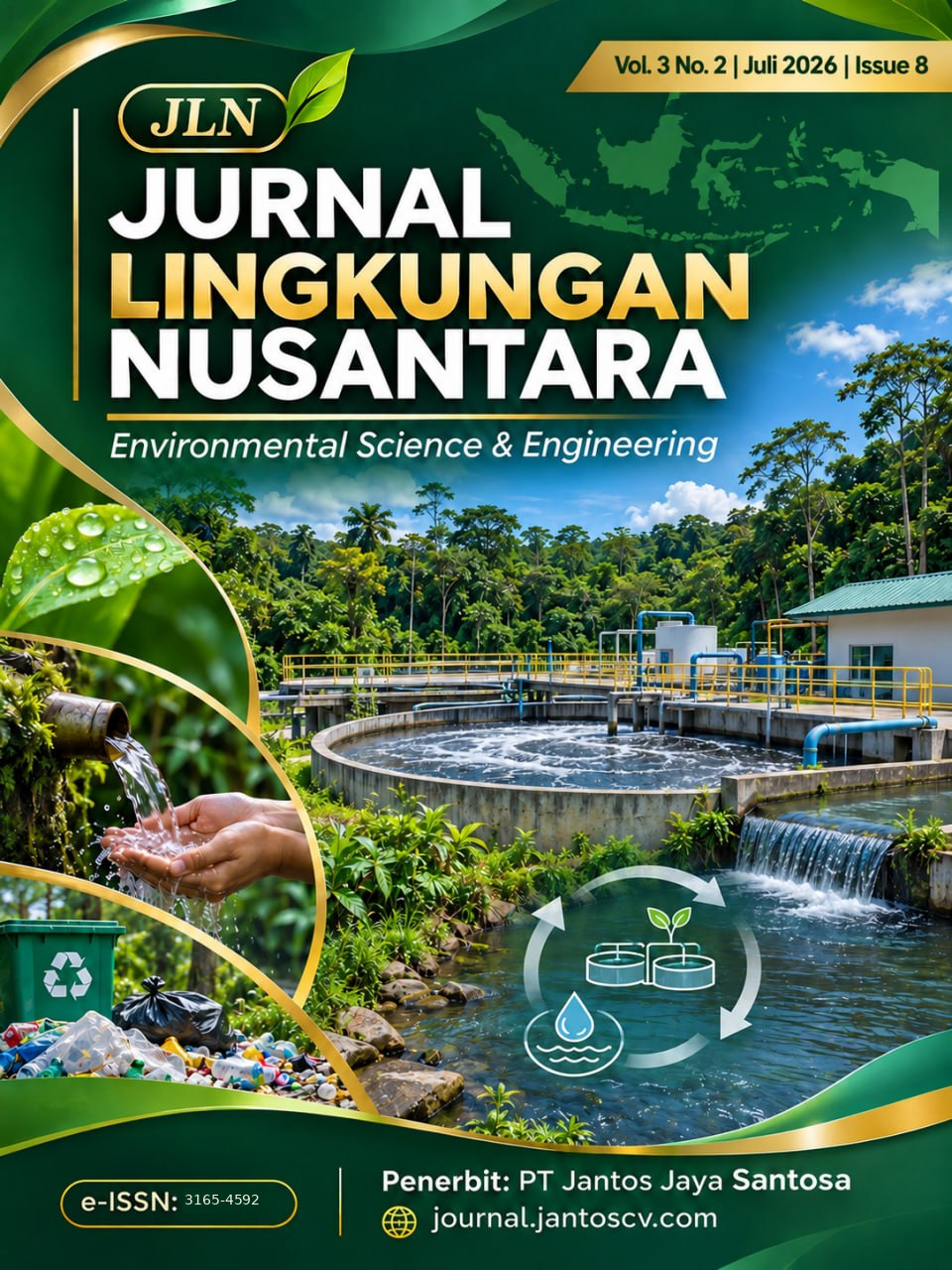
Jurnal Lingkungan Nusantara (JLN), Volume 3 Number 2, July 2026, brings together five environmental science and environmental engineering articles on water quality, wastewater treatment, and resource recovery. It connects environmental assessment with accessible treatment approaches and preliminary designs addressing community and school needs.
The topics comprise physical, chemical, and microbiological assessment of Sendang Panguripan spring in Sragen as a drinking water source; changes in surfactants and phosphate across two retention-time stages of laundry wastewater phytoremediation using water bamboo (Equisetum hyemale); feasibility assessment and preliminary constructed wetland design for school greywater; the potential for Takakura composting of canteen food waste, informed by literature and brief observations; and observations of peat water coagulation using alum in reused bottles. The discussion distinguishes measured findings, potential applications, and designs from demonstrated operational performance. Visually clearer water is not evidence that it is safe to drink without further treatment.
All authors are affiliated with institutions in Indonesia: Kholifah Dina Lestari, Lutfi Eziprasetya, Muhammad Rizky Luthfianto, Izzah Qurroti Aini, Angely Dita Lusy Istifarin, Muhammad Fahmi, Andara Nadien Hapsari, Dhivya Nethania Haryandhira, Ayu Citra Maharani, Imam Sidiq Hidayatulloh, Titi Wahyuni, Sapta Suhardono, and Sunarto at Universitas Sebelas Maret, Surakarta; Mar’atun Saleha, Setiyawan, and Moh. Baitullah Amaludin at Universitas Tadulako, Palu; and Annisa Ramadhianata, Fitri Rahmadani, Muhammad Rizal Amin, Elvi, Betry Apriliana Aldilla, Nabillah Cahaya Widyajauza, Nabila Az-Zahra, Nurhasanah, and Iqbal Maulana at Universitas Muhammadiyah Palangkaraya, Palangka Raya.
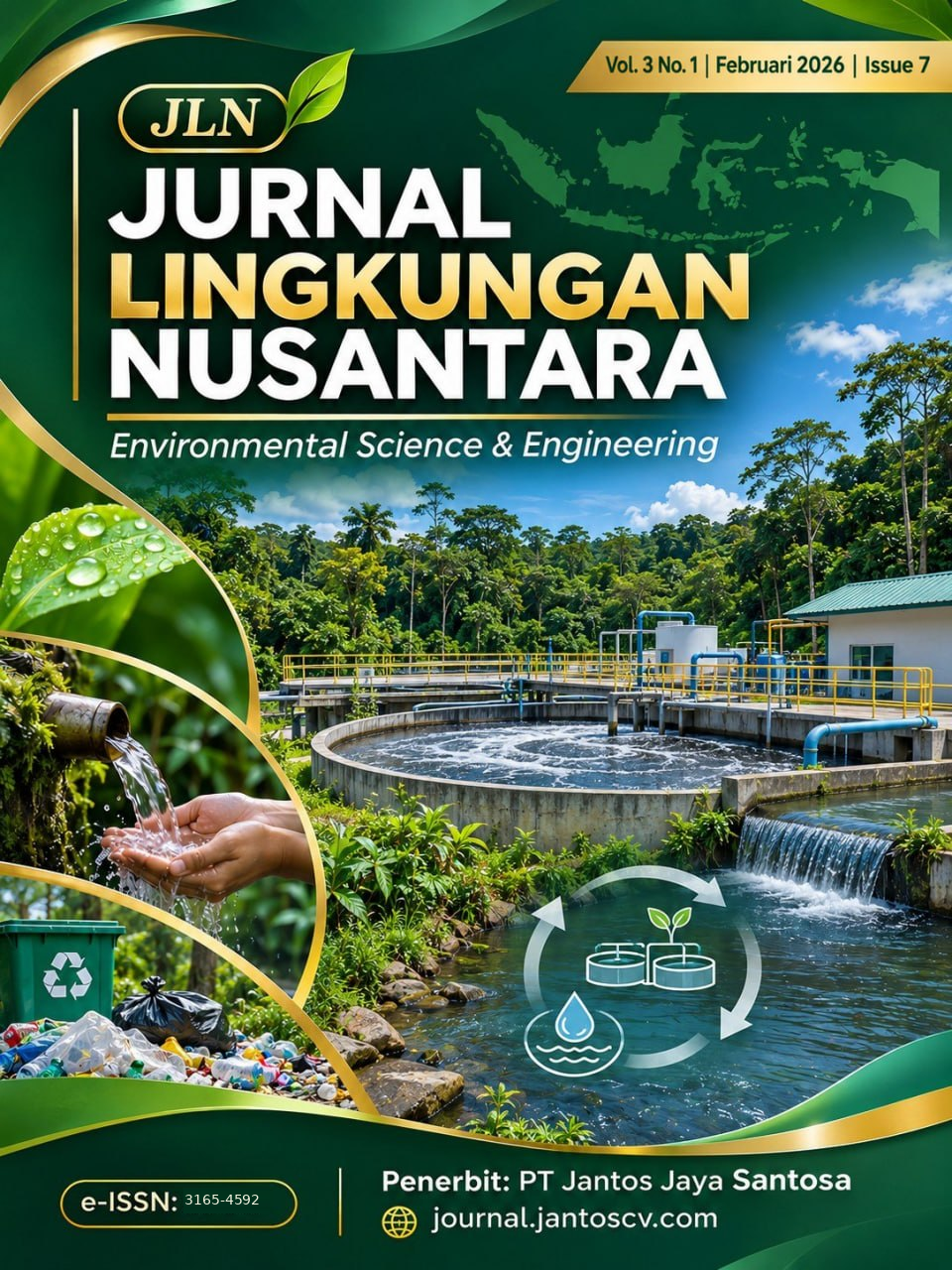
Jurnal Lingkungan Nusantara (JLN), Volume 3 Number 1, February 2026, brings together five articles in environmental science and environmental engineering. The issue connects environmental quality assessment with wastewater treatment, spatial monitoring, and urban exposure evaluation. Its focus spans the relationships between human activities and water, air, and acoustic environments, providing material for scientific discussion of environmental management in locally specific settings.
The five topics are phytoremediation of surfactants and phosphate in laundry wastewater using water bamboo (Equisetum hyemale); mapping NO₂, CO, and SO₂ in Palangka Raya using Sentinel-5P and Google Earth Engine; life cycle inventory and modelling of composting and methane capture scenarios at Bukit Tunggal Landfill; smartphone-based noise measurements around Duta Mall Palangka Raya; and traffic noise assessment around the Bundaran Besar roundabout. These contributions draw on laboratory experimentation, remote sensing, modelling, and field observations. Their findings should be interpreted within the limits of each study design, including the need for controls and replication, measurement validation, and attention to temporal and spatial coverage. The issue thus links monitoring methods with practical questions about pollution and waste management without treating every approach as a demonstrated operational solution.
All authors are affiliated with institutions in Indonesia. Mar’atun Saleha, Setiyawan, and Moh. Baitullah Amaludin are from Universitas Tadulako, Palu. Akhmad Afriyan Noor, Tegar Pratama, Norhalidah, and Muhammad Hikmal Hanafi are from Universitas Muhammadiyah Palangkaraya, Palangka Raya.
This issue contains five research and design articles on drinking-water quality, physical, chemical, and biological parameters of clean water, peat-water filtration, office paper-waste processing, and phytoremediation of tofu wastewater. The articles span pages 29–67 and contribute evidence and design analysis related to water-quality assessment, environmental treatment technology, waste management, and environmental engineering.
The publication of Jurnal Lingkungan Nusantara certainly participates in disseminating the results of community services conducted by lecturers and researchers especially from several universities. This edition contains 5 articles consisting of Environmental Engineering topics.
Share original research or critical analytical studies in environmental science and engineering.
Read the Author Guidelines and Author Fees first.
